Introducing Pod1

In Development

The rack is the deployment quantum

Every cabinet carries thirty-two Photon1 compute nodes and four Scale1 switches across two optical planes, so compute and fabric arrive together — lower it into its slot, cable the overhead trunks, and bring-up walks it into the fabric.

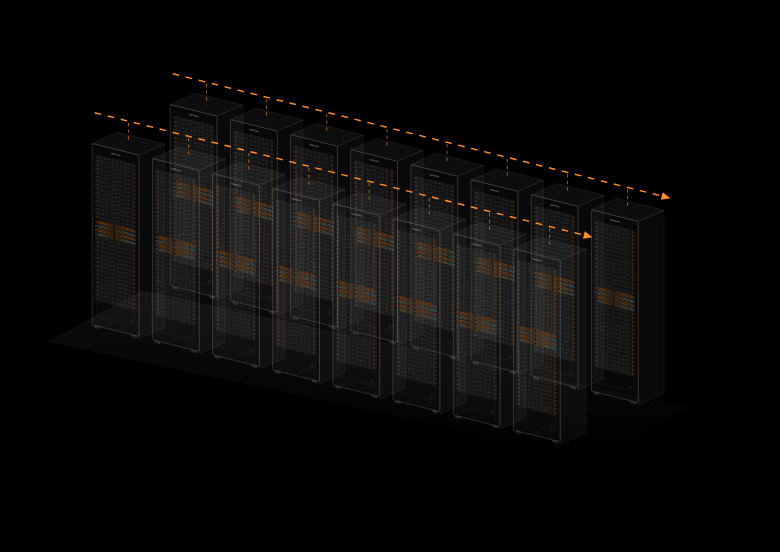
Sixteen racks of thirty-two nodes make a 512-node pod, and the pod’s inter-rack fabric is still glass, end to end.
Pod 16 racks × 32 nodes — 512 nodes per pod
Scale-out 64 + 64 duplex ports per rack into overhead fiber trunks
Fabric Torus, dragonfly, or on-demand topologies via Hyperlane
Boundary All-optical between racks — no OEO at any rack edge
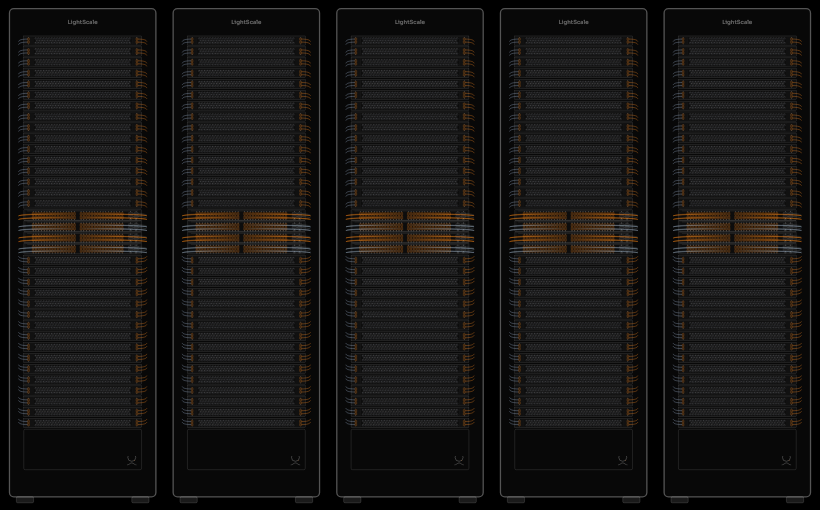
Rack-scale photonic compute Front elevation of the proposed rack-scale system: five identical 42U cabinets side by side, each holding thirty-two 1U PHOTON-1 compute nodes, a central band of four SCALE-1 switches with sixteen compute nodes above and sixteen below, with fiber raceways running in both side channels
A pod in a cabinet, tiled five wide — thirty-two Photon1 compute nodes and four Scale1 switches per rack, every data path in glass.
The pod · sixteen racks · 512 nodes Angled axonometric view of a data-hall pod: two receding rows of eight fully detailed rack cabinets — sixteen racks of thirty-two nodes, 512 nodes — each showing its thirty-two PHOTON-1 compute nodes and glowing SCALE-1 service bands, with shaded cabinet tops and sides for depth; overhead fiber trunks run diagonally above each row with dashed drops into every rack

Deployment quantum

Compute and fabric ship in the same cabinet. A rack lowers into its slot, blind-cables to the overhead trunk, and bring-up walks it into the fabric — one repeatable unit of capacity.

All-glass scale-out

Each rack exposes 64 + 64 duplex ports into overhead fiber trunks that tile the pod into torus, dragonfly, or on-demand fabrics. Between racks, the data path stays optical end to end.

Matched bandwidth

Node-attach and scale-out bandwidth are matched 1 : 1, so the pod has no oversubscription cliff at the rack boundary — and Hyperlane shapes the topology per workload.